Redefining Mental Health Measurement
Founded by a neuroscientist, neuropsychologist, physician and biomedical engineer, Behavidence is on a mission to transform how mental health is measured, monitored, and managed, using the device already in everyone's pocket.
The Problem We're Solving
Depression and anxiety are among the leading causes of disability worldwide, yet the majority of people who experience these conditions go undiagnosed or untreated. Traditional assessment relies on infrequent clinic visits and self-reported questionnaires, methods susceptible to recall bias and limited by the snapshot they provide.
Behavidence addresses this fundamental gap by leveraging digital phenotyping: the analysis of passive, non-identifiable smartphone usage data to generate continuous, objective mental health metrics. Our patented technology extracts 37+ digital behavioral markers to create the Mental Health Similarity Score (MHSS), a clinically validated metric that correlates with standard scales like PHQ-9 and GAD-7.
Understanding Digital Biomarkers
What Are Digital Biomarkers?
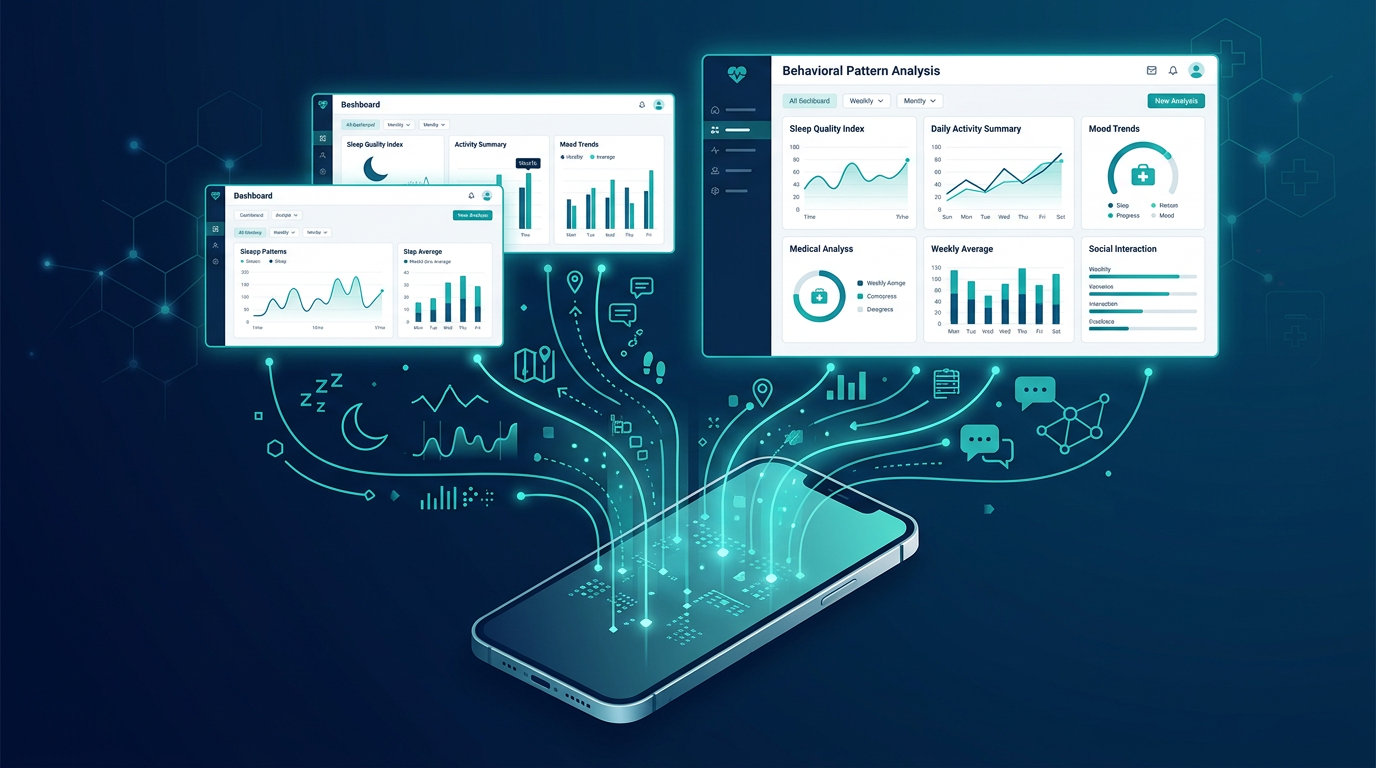
Digital biomarkers are quantifiable physiological and behavioral measures collected through digital devices. In the context of mental health, these include patterns in smartphone usage such as screen time distribution, app switching frequency, interaction timing, and engagement patterns — all collected passively without any content tracking.
The Mental Health Similarity Score (MHSS)
Our proprietary MHSS compares an individual's digital behavioral profile against validated reference populations of people diagnosed with depression, anxiety, and ADHD. Using supervised machine learning classification algorithms, we achieve 87% accuracy for depression detection and 76% for anxiety detection, rivaling many traditional screening methods while requiring zero patient effort.
Why Binary Classification Matters
Our research demonstrates that binary classification models (normal vs. severe) significantly outperform multi-class severity grading when using digital phenotyping data. This approach avoids the bias-creep inherent in self-reported questionnaire severity levels, producing cleaner, more actionable clinical signals. Confidence metrics from these models can then serve as a mechanism for severity grading.
What Drives Us
Unbiased
Our scores are based on pure data and machine learning, not subjective opinion. We use data-driven insights to improve therapy outcomes.
Privacy by Design
Zero identifiable data collected. AES-256 encryption. HIPAA compliant. No messages, typing, or websites visited are ever tracked.
Scientifically Validated
Every metric is backed by peer-reviewed research published in leading journals. We share our knowledge openly with the scientific community.
Innovative
We push the boundaries of digital phenotyping to create new ways of understanding and monitoring mental health conditions.
Transparent
We want to share our knowledge with everyone including the scientific community. This is the only way we can bring about significant change.
Totally Inclusive
Available on iOS and Android with zero user burden. Our technology works passively in the background of everyday smartphone use.